
How to Search Criminal Dockets
For a Platte County criminal docket, the public route is Missouri Case.net. You can search by litigant name, case number, filing date, or scheduled hearings and trials. A name search works when no case number is handy. The number is still the safer tool. It separates matching records from each other. Open the Case Header on a result. Check the court and the parties, then read the docket entries by date. Where access permits, Case.net shows the public case header, judgment details, settings, and links to public documents.
The Circuit Clerk processes Platte County criminal matters and keeps the court record. Treat a web result as a discovery aid, not a certified copy. When an entry points to a record you cannot view online, give the clerk the case number and document title. Then ask for the proper copy route.
- Open Case.net and choose a litigant-name or case-number search.
- Use the defendant name carefully, or enter the full criminal case number when available.
- Confirm that the result is in Platte County and the Sixth Judicial Circuit before opening it.
- Read the Case Header, the date-ordered docket entries, and any listed setting.
- For a needed document or certified copy, identify the case number, filing date, and document title for the Circuit Clerk.
Platte County Criminal Case.net Search
Case.net covers the whole state. A Platte County search may return several court records unless you narrow by court or case number. The litigant route offers last name or business name, first name, middle name, case type, and alias controls. The official public tracking instructions also walk through a Track This Case icon. The icon applies to eligible public matters. Fine Collection Center cases do not get that tracking feature.
Need a future hearing date? Use the scheduled-hearings route, then open the case docket itself. A session listing only names a recurring court block. It cannot replace the case-specific setting, which may have been reset or continued.
Platte County Criminal Case Codes
Missouri’s modern court-number model runs like this. It starts with a two-digit year, then a location code. After that come a category code, a five-digit sequence, and a subcase segment. In a criminal case, the category shows as YY-LOC-CR-00001-01. Older filings break the pattern, sometimes with an R criminal code or another legacy format. So a short pattern is a clue. It is not a rule that fits every older Platte County criminal docket. Separate defendants can carry separate file numbers too.
- CR
- A modern category code used for a criminal case.
- Case Header
- The summary screen that identifies the case before its full docket entries.
- ECASE
- An electronic case record marker; it does not guarantee remote access to every document.
- FTA
- A failure-to-appear entry, which is a court-process event rather than an explanation of why someone missed court.
What a Criminal Docket Shows
Think of a Platte County criminal docket as a chronological event trail. It is not a story of what happened. The record can list the case number, filing date, court or division, case status, assigned judge, party roles, defense attorney, charge information, bond fields, settings, judicial actions, disposition, sentence, and appeal entries. A charge entry is not a plea entry. A judgment entry is its own separate event. Never read a docket label as proof of facts the court record never states.
| Case Number | A local identifier, often with a CR category or a legacy criminal code. |
|---|---|
| Charge and filing | The offense or charging event when the public display makes it available. |
| Settings | Dates for arraignment, pretrial activity, hearing, trial, or another court event. |
| Process entries | Bond, warrant, failure-to-appear, motion, plea, and judicial-action entries as displayed. |
| Disposition | A recorded outcome, judgment date, sentence, or other final-event information. |
File Viewer Help is clear on links. A hyperlinked docket entry may have an attached document behind it. An unlinked entry may simply be unavailable in that viewer. Or it may have no attachment at all. Either way, it does not prove that no paper or electronic filing exists.
Platte County Criminal Charge Events
A criminal docket tends to follow a familiar arc. Complaint, information, or indictment activity comes first, then arraignment and plea, motions, pretrial or status settings, a hearing or trial, judgment, sentencing, and later probation, violation, appeal, or mandate entries. Each step can generate several docket entries. A reset, for instance, only moves the court date. A hearing-held entry only reports that an event took place. Neither one gives you a transcript. Under local rules, transcript preparation runs through the appropriate state office or a certified reporter, paid for by the requester.
Stages on a Criminal Docket
If you want a court date or case status, read the newest entries first, then work backward for context. A filing entry opens the court record. An arraignment or plea entry marks a new stage. Motions and notices may be followed by an order, a later setting, or a reset. A disposition records the court’s outcome, and sentencing or probation activity often follows it. Date order matters here. A later setting generally controls over an earlier one.
Docket flow: Filing → Arraignment → Pretrial → Plea or Trial → Disposition → Sentencing
Platte County Division V Criminal Docket
Local Rule 6.1 assigns misdemeanors and infractions to Division V, subject to listed bad-check and criminal-nonsupport exceptions for Divisions III and IV. DWI, suspended or revoked-license matters, and companion tickets also route to Division V. Felony matters before information are assigned equally between Associate Divisions III and IV. That assignment grid explains why a Platte County criminal docket search needs a case-specific result instead of a broad assumption about one courtroom.
The official Tuesday misdemeanor docket page identifies a Division V session every Tuesday at 1:30 p.m. It is a recurring session notice, not a public list of cases or a promise that every matter can be handled remotely.
The official Division V misdemeanor docket page is the source for this Platte County criminal docket session notice.
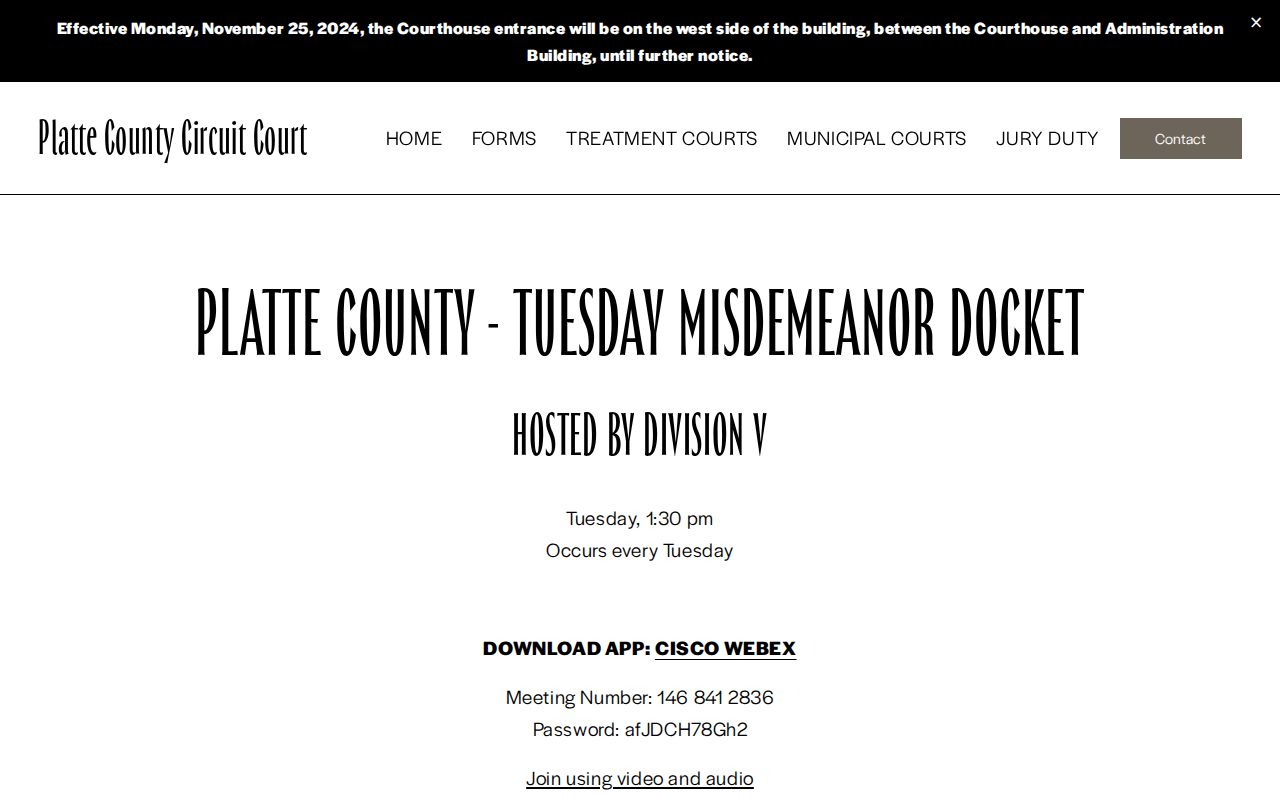
Treat the published session schedule as a lead, not the final word. Check the individual case setting on Case.net or with the clerk before you rely on it.
Platte County Criminal Reset Checks
A continuance or reset can shift a criminal setting after it is first set. Begin with Scheduled Hearings and Trials Search, pull up the matching case, and read down for the newest notice of setting, continuance, or court action. Anything unclear deserves a call to the Circuit Clerk or the assigned division. Do not make the trip until you confirm. Platte County's court contact information lists the local court at 415 Third Street, while county pages also point to a courtroom and counter at 328 Main Street. Those two addresses serve different functions, so verify the location along with the date.
Note: Recurring Webex information can stay posted even when a particular municipal or criminal appearance must happen in person.
Which Court Holds Criminal Dockets
Platte County criminal dockets live in the Circuit Court of the Sixth Judicial Circuit. That court sits in Platte County. It is the core local court system. Elysia Collins, Platte County Circuit Clerk, handles criminal and traffic cases. Her office is the Circuit Clerk's office. Associate divisions take different case categories under local assignment rules. Municipal matters can follow their own municipal division path. Even so, they still use the Sixth Circuit system and Case.net. Smithville is the boundary exception that surprises people. Its municipal instructions send users to Clay County Circuit Court. That court is Division 6 in the Seventh Judicial Circuit.
Probate sits with a separate clerk and division, so it holds no criminal docket. The County Clerk's Sunshine counter handles county administrative records, not ordinary court-case requests. For a criminal case copy or a docket question, go straight to the Circuit Clerk.
Platte County Treatment Court Dockets
Drug, DWI, Wellness, and Veterans treatment-court material adds context to a Platte County criminal docket. But an eligibility page is never a participant roster. A docket entry may show a treatment-court category or a related event. It reveals no confidential program details. That is by design. The local treatment-court pages describe services reaching Platte, Clay, and Ray residents. They publish no current local participant count. Keep any docket search tied to the specific public case record.
The Platte County drug treatment court page helps with program routing. Case.net remains the layer for finding the actual case.
Platte County Criminal Terminal Access
Missouri Court Operating Rules require public-access equipment for automated court records. Court staff can log a public user into a courthouse terminal for public electronic documents. That channel matters for an older filing. It also matters for a pre-remote electronic record, or a document that is public but invisible from home. Platte County publishes no terminal count or lobby location. Ask Circuit Clerk staff where current public electronic access is offered. A terminal never overrides a sealed order or a rule-based confidentiality limit.
The official Missouri Courts eFiling FAQ explains the courthouse-terminal distinction.
The court's Webex index lists remote meeting information. It sits alongside the Platte County criminal docket session details.
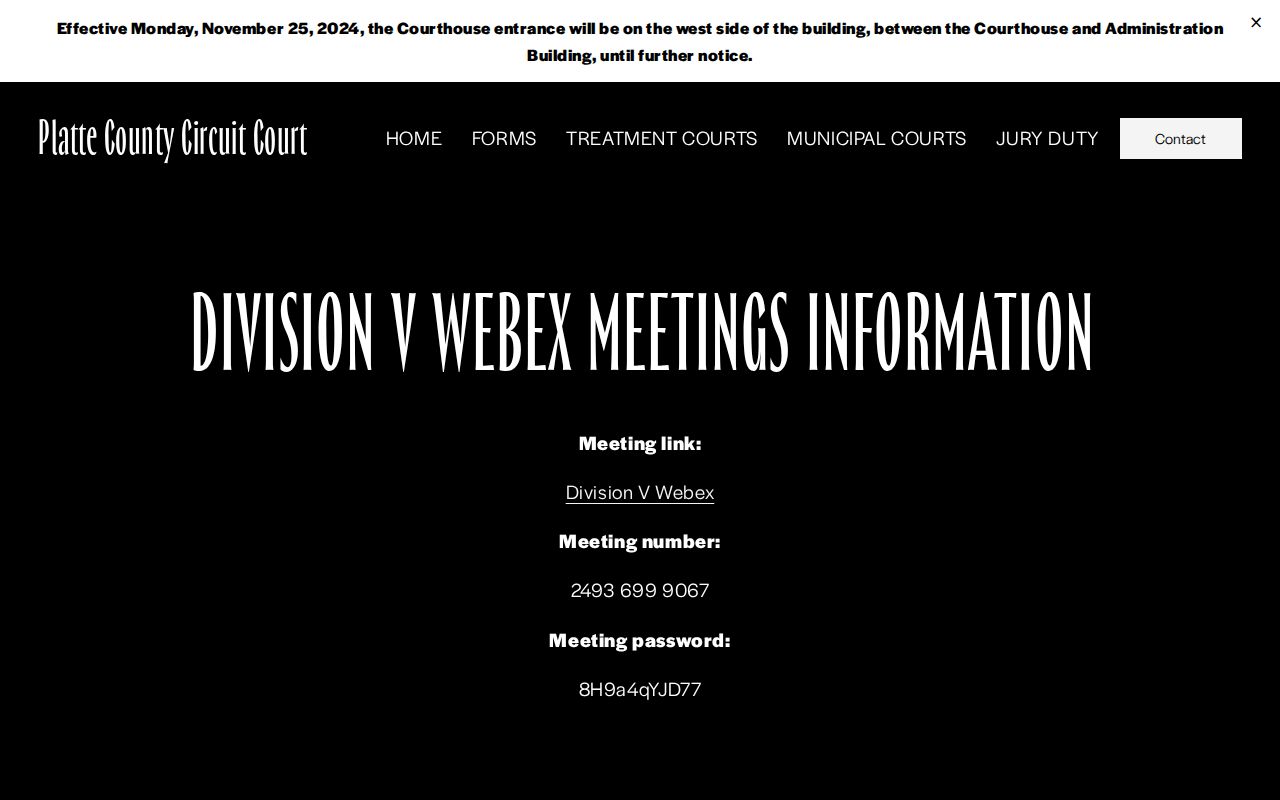
Meeting information can help you spot a division session. Still, the case docket and clerk confirmation are what govern an individual appearance.
Public Access and Sealed Criminal Dockets
Missouri court records are generally open during regular business hours unless a statute, rule, order, or listed exception limits access. Case.net information may be partial. Confidential filing-information sheets, juvenile matters, protected identifiers, certain warrant materials, sealed records, and expunged records all follow special rules. A missing result or dead document link can mean a restriction, a paper or older electronic record, or an access tier. None of it proves absence. It does not establish that a record never existed.
Key Rules:
Missouri Court Operating Rule 2 sets the general presumption of open court records and indexes, subject to exceptions.
Missouri Court Operating Rule 4 addresses automated records, public equipment, docket fields, and confidential information.
RSMo §610.140 governs the expungement process and limits access to closed records as the law provides.
Platte County Criminal Transcript Limits
A docket entry saying a hearing occurred is not a transcript. It is not a recording or complete filing packet either. Local rules send transcript preparation to OSCA Transcribing Services or a certified court reporter. Either way, it is at the requester's expense. Audio recordings are not made generally available. A document link on Case.net helps. Yet a certified court copy must come through the proper clerk process. That line protects the difference between a public docket display and the official record.
To request a Platte County criminal document, the Circuit Clerk's form asks for the case number. It also wants the requested document title, the filing date, mailing details, and a reachable phone number. The form accepts fax and mail submissions.